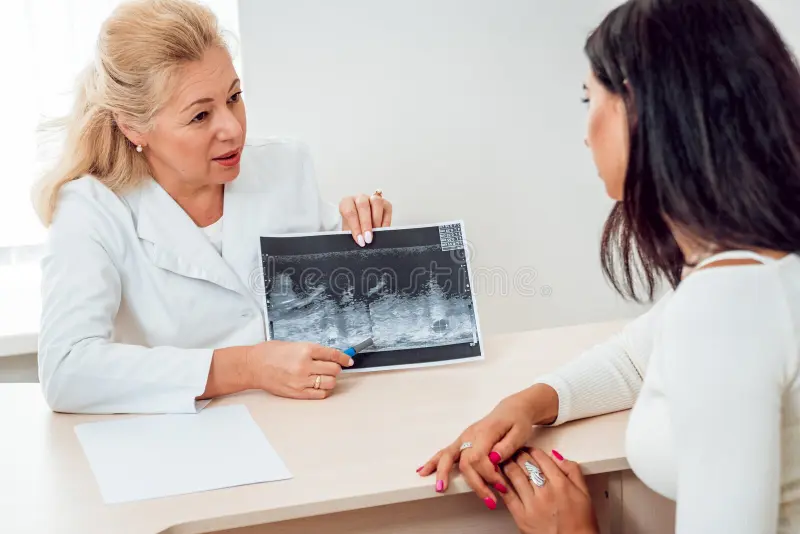
After fat-grafting breast augmentation, some patients develop fat necrosis — areas where fatty tissue becomes damaged and forms hard, sometimes painful lumps. These can cause skin discoloration, unevenness, and discomfort. Fat necrosis can appear as soft oily cysts, complex lumps mixing oily and solid components, or firm calcified masses. While benign, they can be uncomfortable and cosmetically concerning. At Advanced Breast Care Consultants, we offer a minimally invasive revision technique to correct these results and restore a smooth, natural contour.
How We Treat Hardened Fat and Lumps
Our specialists use a proprietary, ultrasound-guided technique to remove oil cysts and hardened fat with precision. A small needle or probe breaks down and dissolves the necrotic fat without disturbing healthy breast tissue. The procedure is performed under local anesthesia with minimal downtime. Recovery depends on the treated area:
- Small areas usually heal within 1–2 weeks
- Larger masses may take up to 4 weeks for full recovery
- Complex areas may need multiple staged treatments
Minimally Invasive
Ultrasound-guided removal under local anesthesia, with little downtime.
Precise & Safe
Targets damaged fat while protecting healthy breast tissue.
Natural Contour
Additional fat grafting can restore smoothness where needed.
Who Is a Candidate for Grafting Revision?
Anyone in good health who has previously undergone fat-grafting breast augmentation and is dissatisfied with the results may be a candidate — common concerns include unevenness, lumps, divots, or hardened fat. Where removal leaves hollowing, additional fat grafting can restore natural contour. We work with an experienced team known for exceptionally low rates of fat necrosis, ensuring refined, natural-looking results.
Most popular and trending Questions?
As part of our commitment to advancing neurological science, we actively engage in cutting-edge research initiatives. By pushing the boundaries of knowledge, we aim to bring about breakthroughs that will shape the future
You can request an appointment through our online contact form or by calling our office during business hours. Our team will help you find a time that works and answer any questions before your visit.
It depends on your insurance plan. Some providers require a referral from your primary care doctor, while others allow you to book directly. We’re happy to help you check your specific requirements.
We work with most major insurance providers. Coverage can vary by plan and service, so we recommend contacting our office to confirm your benefits before your appointment.
Please bring a valid photo ID, your insurance card, a list of any current medications, and any prior imaging or medical records related to your breast health.