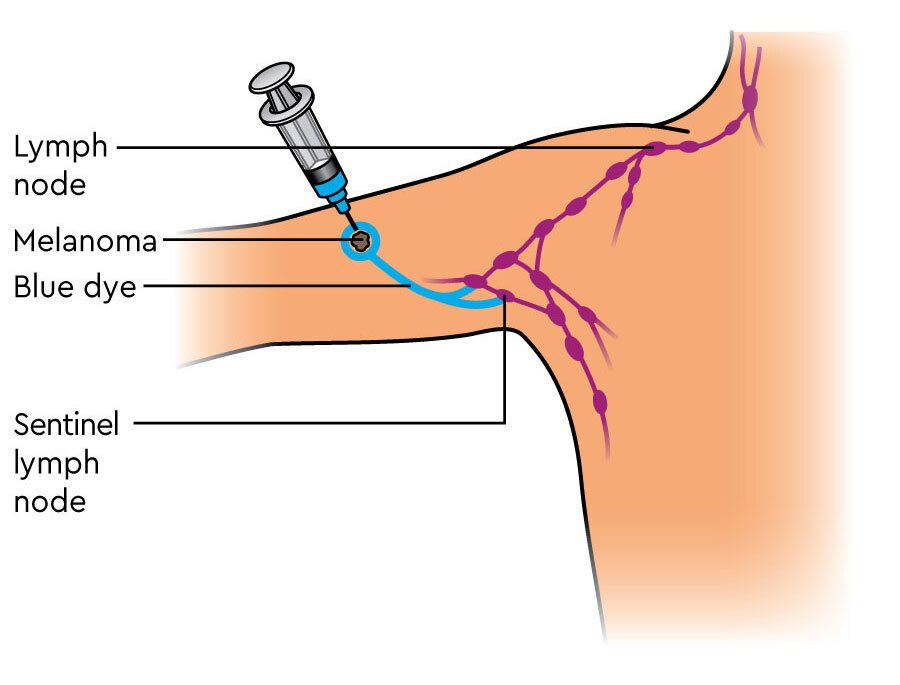
A lymph node biopsy helps determine whether breast cancer has spread beyond the breast. The axillary lymph nodes — located in the armpit — are typically the first place breast cancer travels, so evaluating them is an essential part of accurate staging and treatment planning. Using a technique called sentinel node biopsy, our surgeons examine the first node (or small group of nodes) most likely to contain cancer cells, allowing us to check for spread while minimizing surgical impact and reducing the risk of complications.
How a Lymph Node Biopsy Works
The procedure begins by locating the sentinel node. The surgeon injects a blue dye — and often a radioactive tracer — which travels through the lymphatic system and collects in the key node, making it easy to identify. A small incision is made in a natural crease of the armpit to keep scarring discreet, and the node is removed for pathology
- If the sentinel node is clear — no additional nodes are removed
- If cancer is found — the surgeon removes the other involved nodes to fully address it
Accurate Staging
Reveals whether cancer has spread, guiding the right treatment plan.
Minimally Invasive
Sentinel node technique removes only what's needed, reducing complications.
Discreet Scarring
The incision is placed in a natural armpit crease to stay cosmetically hidden.
Why Choose Us for Lymph Node Biopsy?
The sentinel node technique is now the standard of care because it’s accurate and far less invasive than removing many nodes. By examining only the nodes most likely to be affected, we greatly reduce the risk of lymphedema and other complications, while giving your care team the precise information needed to plan surgery, radiation, and any further treatment.
Most popular and trending Questions?
As part of our commitment to advancing neurological science, we actively engage in cutting-edge research initiatives. By pushing the boundaries of knowledge, we aim to bring about breakthroughs that will shape the future
The axillary lymph nodes are usually the first place breast cancer spreads. Checking these nodes helps determine whether the cancer has moved beyond the breast and is essential for accurate staging and treatment planning.
Surgeons inject a blue dye and sometimes a radioactive tracer before or during surgery. These substances travel through the lymphatic system and collect in the sentinel node, making it easy to locate during the procedure.
Yes. If the sentinel lymph node contains cancer, the surgeon will remove additional involved lymph nodes to ensure the cancer is fully addressed.
The procedure is performed under local or general anesthesia, depending on the surgery type. You may feel some soreness afterward, but most patients tolerate the procedure well.
Risks are low but may include bruising, temporary swelling, infection, or mild discomfort. Removing multiple lymph nodes can increase the risk of lymphedema, but sentinel node biopsy greatly reduces this risk.
Pathology results usually take 1–2 weeks, depending on the complexity of the analysis. Your doctor will review the findings with you and explain what they mean for your treatment plan.
Most patients with breast cancer need lymph node evaluation, but the extent of biopsy depends on tumor size, imaging findings, and surgical plan. Sentinel lymph node biopsy is now the standard because it is accurate and minimally invasive.
Most patients with breast cancer need lymph node evaluation, but the extent of biopsy depends on tumor size, imaging findings, and surgical plan. Sentinel lymph node biopsy is now the standard because it is accurate and minimally invasive.